Thursday, March 10, 2011

Are shantytowns a normal form of urban residence?


People’s views of shantytowns—areas of informal settlement, often by squatters—have varied greatly over the years. Squatters settlements appeared almost overnight around many cities in the developing world in the mid-twentieth century, due to population growth, poverty, and inadequate construction industries. The early reactions were negative: these were seen as chaotic places of high crime and social breakdown. Then fieldwork by anthropologists who lived in these settlements painted a different story: people built their own houses and they worked hard in order to get ahead in the world; crime was low, and family organization remained strong. Although poverty and employment were and are real problems, many scholars and observers came to have a more positive view of shantytowns (Turner 1991).

Although a more positive or tolerant view of shantytowns and their inhabitants became common, many observers still saw the informal and unplanned nature of these settlements as an aberration. In Latin America, for example, Spanish colonial cities had highly planned, rigid, grid layouts, and these created the urban structure for modern city form and expansion. But then came the messy shantytowns. These were seen as a modern development whose lack of planning and organization was attributed to poverty and other forces of the modern world. Traditional cities are well planned, according to the orthodox view, and shantytowns are a chaotic deviation from that pattern.

Some urban scholars, however, pointed out that shantytowns are actually quite an ancient form of urban settlement. The great Argentine urban historian Jorge Hardoy (1982) was the first to suggest this idea, which was then taken up by architectural historians Peter Kellett and Mark Napier (1995), who noted that “The phenomenon of informal urban housing is  not new. Throughout history, the poor have constructed their dwellings around the urban centers of the rich and powerful” (p.8). In his book  Shadow Cities: A Billion Squatters, Robert Neuwirth (2004) goes even further: “the history of cities teaches that squatters have always been around, that squatting was the way poor built homes, that it is a form of urban development (p.179).
Hattusas, Turkey: informal housing next to a temple.

My research on ancient cities bears these ideas out. Some ancient cities did have carefully planned orthogonal layouts of their residential zones (particularly Greek and Roman cities, or places like Teotihuacan), but in many more cities, housing was uneven and informal. Here are four examples of this, two from the Old World and two from the New World. The ancient Hittite capital Hattusas (in Turkey) was laid out on a mountainside. Next to a temple compound are a series of irregular house foundations (in the area circled in red in the photo). The contrast with the much more regular layout of the temple is striking. (Bryce 2002; Neve 1996).
Tell Asmar, and early Mesopotamian city

Moving back in time to ancient Mesopotamia, the birthplace of the Urban Revolution, most commoner housing at these cities is densely packed and irregular in size and layout. Tell Asmar is fairly typical. It looks like individual families built their own houses without much planning or direction from city authorities. (Hill 1967; Ur n.d.)

Chan Chan, Peru.
This kind of urban informal housing is the dominant form at most of the ancient cities in the New World. Chan Chan, the huge capital of the pre-Inka Chimor Empire on the coast of Peru, contains ten large walled royal compounds. Outside of these, informal housing was thrown up, often against the outer wall of the compound. (Moseley and Mackey 1974; Topic 1982)

And finally, the scattered nature of housing at Classic Maya cities provides a strong contrast to the carefully planned pyramids and palaces of the city centers. At Copan in Honduras, the huge Acropolis was the center of government and state ritual, and the nearby housing shows an informal pattern. Now some of my Mayanist colleagues may object to calling Maya cities shantytowns. After all, the Mayas were the "Greeks of the New World," a people with advanced intellectual and aesthetic abilities. That may be, but these were self-built, unplanned and informal neighborhoods, clustered around the city center. This sounds like a
Copan: informal housing adjacent to the royal acropolis.
shantytown to me. (Andrews and Fash 2005; Webster et al. 2000).

Unfortunately, archaeologists have been slow to analyze ancient urban housing, and comparisons with modern shantytowns are in their infancy; I discuss the situation in Smith (2010). But it is clear to me that Hardoy and the other scholars quoted above are correct that shantytowns or squatters settlements were important parts of the urban landscape in ancient times. They pre-dated the carefully planned orthogonal housing of the Greeks and Romans, and so perhaps we can call shantytowns "a normal form of urban residence." They are certainly a big part of the wide urban world.

References:

Andrews, E. Wyllys IV and William L. Fash (editors)
2005    Copán: The History of an Ancient Maya Kingdom. SAR Press, Santa Fe.

Bryce, Trevor R.
2002    Life and Society in the Hittite World. Oxford University Press, Oxford.

Hardoy, Jorge E.
1982    The Building of Latin American Cities. In Urbanisation in Contemporary Latin America: Critical Approaches to the Analysis of Urban Issues, edited by Alan G. Gilbert, pp. 19-34. Wiley, London.

Hill, Harold P.
1967    Tell Asmar: The Private Home Area. In Private Houses and Graves in the Diyala Region, edited by Pinhas Delougaz, Harold P. Hill, and Seton Lloyd, pp. 143-181. Oriental Institute Publication, vol. 88. University of Chicago Press, Chicago.

Kellett, Peter and Mark Napier
1995    Squatter Architecture? A Critical Examination of Vernacular Theory and Spontaneous Settlement with Reference to South America and South Africa. Traditional Dwellings and Settlements Review 6(2):7-24.

Moseley, Michael E. and Carol J. Mackey
1974    Twenty-four Architectural Plans of Chan Chan, Peru: Structure and Form at the Capital of Chimor. Peabody Museum Press, Cambridge.

Neuwirth, Robert
2004    Shadow Cities: A Billion Squatters, a New Urban World. Routledge, New York.

Neve, Peter
1996    Housing in Hattusa, the Capital of the Hittite Kingdom. In Tarihten Günümüze Anadolu'da Konut ve Yerlesme / Housing and Settlement in Anatolia: A Historical Perspective, edited by Yildiz Sey, pp. 99-121. Tarih Vakfi, Istanbul.

Smith, Michael E.
2010    Sprawl, Squatters, and Sustainable Cities: Can Archaeological Data Shed Light on Modern Urban Issues? Cambridge Archaeological Journal 20:229-253.

Topic, John
1982    Lower-Class Social and Economic Organization at Chan Chan. In Chan Chan: Andean Desert City, edited by Michael E. Moseley and Kent C. Day, pp. 145-175. University of New Mexico Press, Albuquerque.

Turner, John F. C.
1991    Housing by People: Towards Autonomy in Building Environments. Marion Boyars, London.

Ur, Jason
n.d.      Bronze Age Cities of Southern Mesopotamia. In Blackwell Companion to the Archaeology of the Ancient Near East, edited by D. T. Potts, pp. _____ (in press). Blackwell, Oxford

Webster, David, AnnCorinne Freter, and Nancy Gonlin
2000    Copán: The Rise and Fall of an Ancient Maya Kingdom. Case Studies in Archaeology. Harcourt College Publishers, New York.


Sunday, March 6, 2011

Temporary Cities: Burning Man, Quartzsite, and Chalma


“Black Rock City” exists as a human settlement for only eight days each year. The rest of the time, it is an empty patch of arid desert. Chalma is a small Mexican village (less than 2,000 inhabitants) that swells to 50,000 inhabitants for a few days each year. The town of Quartzite in the Arizona desert is a bustling town of tens of thousands for half the year, but a sleepy village of hundreds the other half. Should we call these places “cities”? They clearly violate one of the four points in Louis Wirth’s influential definition of urbanism—permanence. But they share enough characteristics with other urban settlements to warrant the label “temporary cities.” This view is shared by Nate Berg, who has written about Black Rock City and Quartzite.


Black Rock City, of course, is the name of the temporary settlement that houses the annual Burning Man festival in the Nevada desert. Thousands of people gather each summer for several days of artistic expression, parties, and semi-communal living. When the festival is over, everything is cleaned up and the desert put back to pristine shape. For comparative urbanism, there are many interesting things about Burning Man and Black Rock City. There are lots of books, articles, blogs, etc. on the festival. A sociologist has written a book about how the festival is organized (Chen 2009). Nate Berg’s article on the Places website explores some of the urban issues, and his conclusion is worth quoting:
And as Burning Man has grown from a small gathering into a temporary city, attendees have become more intimately involved in the community around them, empowered to enact the changes on whatever scale is necessary to improve their quality of life during their eight days in the desert. It's city-making at the individual level…. People realize that they can do things — maybe small things — that improve how they experience and interact with their fellow citizens. To create power in that way doesn't require a political office or city budget, only the desire to make life better. Community improvement through community participation is not difficult to achieve. It happens every year at Burning Man. And possibly beyond.
One of the things I find interesting about Black Rock City is the relationship between city growth on the one hand, and centralized planning and organization on the other. The early years had few rules or established plans. People began to form neighborhoods informally based on interests and year-to-year friendships. But in 1997 the festival grew too large for informal organization; people were shooting off guns, driving cars too fast through campsites, and some participants were injured. So the organizers stepped up the formal regulation and planning of the settlement, creating the circular plan and a number of rules and regulations (including rules about neighborhood structure). 

 Quartzsite is a temporary city for a very different social clientele. The city becomes a mecca for “snowbirds” in their RV’s each winter (snowbirds are the northerners who flock to Arizona each winter). A city springs up in the desert, but a months-long city of RV’s, not a days-long city of tents as in Black Rock City. The mobile retirees form neighborhoods and enjoy urban life. Nate Berg’s article in High Country News gives a good picture of Quartzsite as a temporary city, although many questions remain. Because of our project on comparative urban neighborhoods, I am particularly curious about how the neighborhoods form at Quartzsite: is the composition consistent year to year? Why are some groupings large and others small? Just how close are social relationships within these spatial clusters of RV vehicles? How much planning or organization is provided by authorities in Quartzsite? Ethnographers and planners have studied the RV lifestyle (Counts and Counts 1996; Simpson 2007), but like Black Rock City, this and other RV destinations cry out for more attention from urban scholars.

Lest one think that temporary cities are a contemporary innovation, consider pilgrimage destinations. Chalma is a sleepy rural village in the mountains west of Mexico City. But there are important relics in the local shrine, and millions of pilgrims come to Chalma each year. It is the second-largest pilgrimage destination in Mexico, after the Guadalupe Basilica in Mexico City. During the annual festival, the village swells to over 50,000 residents. These people have to be fed and sheltered, and order has to be maintained somehow. For over four hundred years Chalma has been the setting of a temporary city (Benuzzi and Fay 1981; Rodríguez-Shadow and Shadow 2000).

I hope you did not miss my use of the term “mecca” to describe Quartzsite above. The city of Mecca, of course, is the largest pilgrimage destination in the world. For centuries, each year has seen millions of pilgrims make the hajj, the pilgrimage to Mecca. Mecca is a large city all year round, and has been for many centuries. But when its ranks swell by many millions of residents for the main festival, the urban issues (food, water, shelter, sanitation, crowd control) multiply accordingly. Chalma, however, is more typical of temporary pilgrimage cities around the world in the past and present. I haven’t heard of anyone studying these places for their urban insights, but such a study would make a fascinating and important contribution to urban studies. Temporary cities are part of the wide urban world, and they have much to teach us about cities, urbanization, and human life in cities.

References:

Benuzzi, Silvia and George E. Fay (editors)
1981    A Pilgramage to Chalma: The Analysis of Religious Change. Museum of Anthropology, University of Northern Colorado, Greeley, CO.


Chen, Katherine K.
2009    Enabling Creative Chaos: The Organization Behind the Burning Man Event. University of Chicago Press, Chicago.

Counts, Dorothy A. and David R. Counts
1996    Over the Next Hill: An Ethnography of RVing Seniors in North America. Broadview, Peterborough, Ontario.

Rodríguez-Shadow, María J. and Robert D. Shadow
2000    El pubelo del Señor: Las fiestas y peregrinaciones de Chalma. Universidad Autónoma del Estado de México, Toluca.

Simpson, Deane
2007    RV Urbanism: Nomadic Network Settlements of the Senior Recreational Vehicle Community in the US. Paper presented at the Conference, Temporary Urbanism: Between the Permanent and the Transitory.  http://www.holcimfoundation.org/Portals/1/docs/F07/WK-Temp/F07-WK-Temp-simpson02.pdf.


Wednesday, March 2, 2011

Addis Ababa in 1900: A “collection of villages” that was capital of an empire

At the end of the nineteenth century, Addis Ababa was a city of 100,000 and capital of a large empire. Emperor Menelik II was one of the most powerful rulers in the world. He had defeated the Italian army, and European diplomats and missionaries were beating a path to his door to win favor and make deals (figure 1).

Yet when safari hunter Percy Powell-Cotton visited the city in 1900 he was less than impressed with its the size and grandeur: “Dotted across the plain were clusters of huts, many stockaded enclosures—large and small—and several camps, but all very much scattered and more resembling a collection of villages and farmsteads than the capital of a great empire.” (Pankhurst 1985:213).

Aren’t imperial capitals supposed to be large imposing cities with huge stone monuments? Think of ancient Rome or Beijing or Tenochtitlan. If the idea that a low-density settlement in the jungle—without big stone buildings—could be a powerful capital sounds incongruous, it is because of two western biases. First, a century ago many people thought that “natives” in tropical areas of the developing world were incapable of building cities or large empires. Today most people know better because archaeologists have uncovered material evidence for the accomplishments of the kings of tropical cities like Angkor, Tikal and Great Zimbabwe.

The second bias is still with us: the notion that cities have to be large places with many thousands of residents living in dense residential quarters (see my earlier discussion of the demographic definition of urbanism). Low-density settlements are often seen as something less than urban, which would make the notion of a low-density imperial capital incongruous. This bias has a long history in western culture. More than two millennia ago the Athenian Thucydides disparaged the Spartan capital as follows: “Since, however, the city is not regularly planned and contains no temples or monuments of great magnificence, but is simply a collection of villages, in the ancient Hellenic way, its appearance would not come up to expectation” (Thucydides 1972:41, book 1, section 10). The same metaphor was expressed by archaeologist William Sanders who made an effort to portray Maya cities as non-urban settlements in comparison with Teotihuacan. He called Tikal “a gigantic cluster of hamlets with intervening areas of light settlement” (Sanders 1979:397). It is hardly surprising that Sanders was for decades the leading archaeological proponent of Louis Wirth’s demographic definition of urbanism.
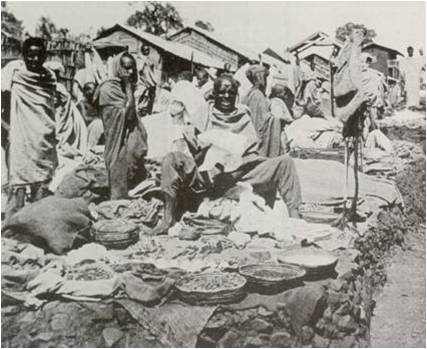
But if we take the functional definition of urbanism (that is, cities are places whose activities and institutions affect a larger hinterland), then a place like Addis Ababa in 1900 was clearly an urban settlement. It was not only a major market center and focus for craft production, but it was an imperial capital. It is a good example of the low-density city, a type of settlement common in many tropical areas prior to European expansion. Roland Fletcher (2009) has made the most systematic comparative study of these low-density cities. What were they like? While it is difficult to get a close appreciation of the urban feel of ancient Tikal or Angkor at their height, early photographs and descriptions of Addis Ababa allow us into one of the last great tropical low-density cities.

We can probably forgive safari hunter Powell-Cotton for calling Addis Ababa a collection of villages. Early photographs show that there was considerable open space within the city. Most of this land was not empty lots, but rather gardens, fields, orchards, and pastures (Gascon 1995:15). People lived in clusters of houses, typically grouped around the compound of important people. These clusters served as urban neighborhoods—places where people interacted on a daily basis and took care of many activities and affairs. Edward Gleichen visited Addis Ababa in 1897 and published an excellent map of the city (Gleichen 1971:endpiece). One portion of that map is included here. It clearly shows the clusters of huts that made up the neighborhoods; these were called sefer in Amharic.

While Addis Ababa as shown in these historic photos may not look very “urban” to us today, it is hard to avoid the labels of city and urban for a powerful imperial capital with 100,000 residents. Low-density cities like this show the variation in urban forms around the world and through time, and they occupy an important niche in the wide urban world.

References

Biasio, Elisabeth
2004    Prunk und Pracht am Hofe Menileks: Aflred Ilgs Athiopien um 1900 / Majesty and Magnificence at the Court of Menilke: Alfred Ilg's Ethiopia around 1900. Verlag Neue Zürcher Zeitung, Zürich.
Fletcher, Roland
Gascon, Alain
1995    La naissance du paysage urbain à Addis Ababa. In Fotografia e storia dell'Africa, edited by Alsessandro Triulzi, pp. 11-25. Istituto Universitario Orientale, Naples.
Gleichen, Edward
1971    With the Mission to Menelik, 1897. Gregg International Publishers, Farnborough, England.
Pankhurst, Richard
1985    History of Ethiopian Towns From the Mid-Nineteenth Century to 1935. Franz Steinter Verlag, Stuttgart.
Pankhurst, Richard and Denis Gérard
1996    Ethiopia Photographed: Historical Photographs of the Country and its People Taken Between 1867 and 1935. Kegan Paul International, London.
Sanders, William T.
1979    The Fon of Bafut and the Classic Maya. In 42nd International Congress of Americanists (Paris, 1976), pp. 389-399, Paris.
Thucydides
1972    The History of the Poloponnesian War. Translated by Rex Warner. Penguin, New York.

Figures:
1. Menelik's court (from the internet).
2. Addis Ababa, 1890, looking toward the palace at the top of the hill (Biasioi 2004: 76).
3. Addis Ababa, 1900, market (Pankhurst & Gérard 1996:114).
4. Map, redrawn from Gleichen (1971: Endpiece).
5. Menelik II (from the internet).


Tuesday, February 22, 2011

What is a city? Definitions of the urban

What is a city? How do we distinguish urban from non-urban settlements in ways that make sense? Does it matter how we define cities, or is definition just a sterile typological exercise? Definition is crucial for comparison. If we are going to compare cities, or parts of cities, then it helps to have a clear and explicit notion of what we are talking about. In my field, archaeology, there are two main kinds of definitions of the city, based on two of the important characteristics of cities. The demographic definition is based on the idea that cities are big places with lots of people, while the functional definition flows from the notion that cities have an impact on their surroundings. Neither definition is “correct” or “best.” Rather, they are more or less useful for various kinds of purposes.

The Demographic Definition

This definition was first codified by sociologist Louis Wirth in his influential 1938 paper, “Urbanism as a way of life” (Wirth 1938).  Cities, according to Wirth, are defined by four characteristics:

1.      Permanence
2.      Large population size
3.      High population density
4.      Social heterogeneity
This sounds pretty good to most modern ears. It certainly fits contemporary cities, although there is always room for quibbling with quantitative definitions (How many people? How much heterogeneity?). To use the demographic definition, one looks at a settlement, makes some measurements, and decides whether or not it is a city.

The Functional Definition of Urban

Although there may be precursors, most modern functional definitions of cities derive from mid-20th century economic geography, where central place theory focused on the regional distribution of retail market centers. Market centers provisioned a hinterland, and the larger the hinterland (and the more goods and services provided), the more important the center. In these models retail marketing is an urban function—an activity or institution located within a settlement that affects people and places beyond the settlement. Later developments in anthropology and geography expanded the notion of urban function beyond economics to include politics and religion (Fox 1977). From this perspective, the Classic Maya jungle cities can be considered urban because their kings ruled city-states larger than the individual settlement, and their temples were the focus of worship for peasants as well as urban dwellers. From the demographic perspective, on the other hand, the Maya centers were not big enough to be called cities. To use the functional definition, one cannot simply look at a settlement and decide whether it is urban; one has to look at the entire regional context, including the hinterland and other nearby settlements. If the settlement in question was the setting for people and institutions that impacted a larger realm, it can be considered an urban settlement.

I generally prefer the functional definition, and I’ve argued in its favor on and off over the years (Smith 1989, 2008). I don’t feel that it is inherently better than the demographic definition, only that it contributes more to advancing research and understanding in some of the topics I work on. A good example is the Classic Maya, the urban status of whose capitals was the subject of a lengthy debate. In a series of publications starting in the 1960s, William Sanders applied Louis Wirth’s demographic definition of urbanism to ancient Mesoamerica. In his perspective, Teotihuacan (over 100,000 population; density ca. 5,000/km sq) was a clearly a city, but Tikal and the other Maya centers were not sufficiently big or dense or socially complex to be called cities. If the goal is to analyze how large dense cities differ from smaller more dispersed settlements, then the demographic definition makes sense. The urban experience must have been radically different for the residents of Teotihuacan compared to the residents of Tikal or Copan.

On the other hand, if one is interested in how the Maya centers affected their hinterlands, or the nature of their political, religious or economic influence, or how the inhabitants of the Maya landscape were linked together by polities or market systems or religious communities, then the demographic definition is of little help. The functional definition of urbanism acknowledges Tikal and Copan as urban centers, and this helps us understand how Maya society worked on a regional scale.

One of the things I like about the functional definition of urbanism is that it allows us to talk about different kinds of cities: political capitals, religious centers, economic centers, and other types. Sometimes the type of city differs among urban traditions. Swahili cities were trade centers, whereas most Maya cities were political-religious centers. And sometimes a single society has different functional types of cities. Just as the United States today has such diverse cities as Washington, DC, New York City, and Miami, so too did Aztec central Mexico have an imperial capital (Tenochtitlan), ritual centers (Malinalco), and city-state capitals (many examples).

Definitions help orient us in a field, they aid comparison, and they help us understand urban societies and their transformations. There is more to say about the topic, which I will return to in a future post.

References

Fox, Richard G.
1977    Urban Anthropology: Cities in their Cultural Settings. Prentice-Hall, Englewood Cliffs.

Smith, Michael E.
1989    Cities, Towns, and Urbanism: Comment on Sanders and Webster. American Anthropologist 91:454-461.

2008    Aztec City-State Capitals. University Press of Florida, Gainesville.

Wirth, Louis
1938    Urbanism as a Way of Life. American Journal of Sociology 44:1-24.


Wednesday, February 16, 2011

How do we compare cities? OR, Does this logo make sense?

I had fun creating the logo for this blog. Can you identify the places? (I almost wrote, "can you identify the CITIES". Oops. One of them is not a city. Oops, maybe THREE of them aren't cities. How do we define cities? Well, that will be another post).

These are the places in the logo above:
1. Chichen Itza
2. Stonehenge
3. A generic Medieval European city gate
4. New York City
5. Angkor

Now Stonehenge was definitly NOT a city. So what is it doing in my logo? This is actually a serious question. I didn't pick Stonehenge for aesthetic purposes (well, not entirely for aesthetic reasons). Its inclusion can be viewed as an intellectual statement about comparative urbanism.

Stonehenge is relevant to comparative urbanism because as a large public monument, it shares physical properties, and social implications, with urban public monuments (such as the other elements of the logo). Monuments communicate information about their builders and about their social context, and they have an influence on individuals and society. These issues are part of architectural communication theory, a body of thought associated with Amos Rapoport (his best book, in my mind, is The Meaning of the Built Environment: A Nonverbal Communication Approach, Univ. Arizona Press, 1990). Or see my paper on urban theory, where I cover this and other theoretical approaches to ancient cities.

Cities are complex and messy things, and it is difficult to compare them. As a scholar, I find it far too complicated to make big comparisons of whole cities. Much more useful are comparisons of specific parts of cities (housing, or streets, or parks), or comparisons of specific urban processes (transportation, or manufacturing), or specific urban conditions (homelessness, or health care, or symbolic meaning, or poverty).

Stonehenge was not a city, and it was not part of a state-level society. As such, whole-settlement comparisons of Stonehenge with, say, the four cities in the logo, would not be very informative. On the other hand, specific smaller-scale comparisons of the monument of Stonehenge with some ancient urban monuments could be enlightening and might help us better understand the role of monuments in society. So Stonehenge, while NOT an urban feature, is relevant to research in comparative urbanism that focuses on a smaller scale than whole cities. It is definitely relevant to the wide urban world (and it looks pretty good, too).

Sunday, February 13, 2011

Were ancient cities sustainable ?


ResearchBlogging.org

As an archaeologist, I have a very different view of sustainability than most scholars who study the contemporary world. For sustainability today, one of the standard definitions is that of Gro Harlem Bruntland: “Sustainable development is development that meets the needs of the present without compromising the ability of future generations to meet their own needs.” There is much debate and discussion about this definition and its usefulness, but the dual components of current practices and potential future outcomes are fundamental for most writers.

Archaeology deals with human society over long time spans—centuries and even millennia. For me, a sustainable society is one that lasts for a long time. In central Mexico, Teotihuacan society flourished for five centuries or more, while many of the societies that came later were only around for a couple of centuries before collapsing. Teotihuacan was far more sustainable. People sometimes wonder why Classic Maya civilization collapsed, assuming that their society and practices must have been defective. But the Maya cities lasted even longer than Teotihuacan. My own society in the USA has lasted less than half as long as the Classic Maya, so perhaps the Maya had a more sustainable society than we have today.

As for urban sustainability, consider these three definitions:

• “a sustainable city is one in which the community has agreed on a set of sustainability principles and has further agreed to pursue their development” (Munier 2007:17).
• “For cities, I have defined sustainability as reducing Ecological Footprint (energy, water, land materials, waste) while simultaneously improving quality of life (health, housing, employment, community) within the capacity constraints of the city” (Newman 2006).
• “when we talk about urban sustainability, we should consider several issues: survival of the settlement through time, environmental impacts on landscapes, and quality of life for inhabitants” (Grant 2004:24).

The first definition cannot be applied to ancient cities. Even if people in ancient Babylon, say, had agreed on sustainability principles (a laughable idea), we would not have any evidence of this today. The second definition at least makes sense to an archaeologist. But only the third definition (by Jill Grant) is really applicable to ancient cities.

The study of modern urban sustainability does not ask whether cities will fail or not, but whether a given quality of urban life can continue into the future. One reason for this neglect of what seems an obvious question to an archaeologist is the fact that, in the words of Thomas Campanella (2006:142), “the modern city is virtually indestructible.” Research on the effects of natural disasters on contemporary and recent cities shows that modern cities (from Beirut to New Orleans) nearly always survive just about anything that nature or people can throw at them.

The reasons for the resiliency of modern cities in the face of physical disaster are listed by Campanella (2006:142):

1. modern nation states have a vested interest in the well-being of their cities.
2. private property laws ensure the continuing organization of urban space, even after physical destruction.
3. the modern insurance industry lessens economic impacts of disasters.
4. urban infrastructure is complex and multilayered, and is rarely destroyed totally.

These conditions do not hold for most preindustrial cities, making it difficult to compare ancient urban sustainability (how long did cities survive?) with modern sustainability (can present lifestyles continue into the future?). Campanella (2006:141) goes on to suggest that the situation was only slightly different in the past. He asserts that after A.D. 1100 very few cities were destroyed or abandoned. Now any archaeologist who has undertaken a landscape survey knows this is not the case; landscapes all over the world are littered with destroyed and abandoned urban sites. Many ancient cities failed, but should we consider them sustainable or not? This is a topic that needs much more research by archaeologists. The current infatuation with societal collapse (e.g., Diamond 2004) takes our perspective away from sustainability and gives a biased picture of ancient societies. Instead of claiming that the Classic Maya were deficient because their cities collapsed, perhaps we should call them wildly successful for forging a vibrant civilization in a harsh environment that lasted for many hundreds of years.

I find it remarkable that even in the absence of the kind of modern urban safety net described by Campanella, many ancient cities managed to survive for many centuries, and some lasted for millennia (think of Rome or Babylon or Jerusalem). This sure sounds like sustainability to me.

This post is based on some of the themes in Smith (2010).


REFERENCES:

Campanella, Thomas J.
2006 Urban Resilience and the Recovery of New Orleans. Journal of the American Planning Association 72:141-146.

Diamond, Jared
2004 Collapse: How Societies Choose to Fail or Succeed. Viking, New York.

Grant, Jill
2004 Sustainable Urbanism in Historical Perspective. In Towards Sustainable Cities: East Asian, North American and European Perspectives on Managing Urban Regions, edited by André Sorensen, Peter J. Marcutullio, and Jill Grant, pp. 24-37. Ashgate, Burlington, VT.

Munier, Nolberto
2007 Introduction. In Handbook on Urban Sustainability, edited by Nolberto Munier, pp. 17-88. Springer, Dordrecht.

Newman, Peter
2006 The Environmental Impact of Cities. Environment and Urbanization 18:275-295.

Smith, Michael E.
2010 Sprawl, Squatters, and Sustainable Cities: Can Archaeological Data Shed Light on Modern Urban Issues? Cambridge Archaeological Journal 20:229-253.

Smith, M. (2010). Sprawl, Squatters and Sustainable Cities: Can Archaeological Data Shed Light on Modern Urban Issues? Cambridge Archaeological Journal, 20 (02), 229-253 DOI: 10.1017/S0959774310000259

Sunday, February 6, 2011

Droughts and the decline and rise of urban civilizations

ResearchBlogging.org

The role of climate change in the collapse of ancient civilizations has become a popular topic, among both scholars and the public. Jared Diamond’s book Collapse (Diamond 2004) remains a best-seller, and it has generated considerable discussion and debate. This week a new technical study on ancient climate in central Mexico was reported (Stahle et al. 2011) (click here for more information) and it may transform our views of urban development in central Mexico. The authors have constructed a tree-ring chronology in the Mexican state of Queretaro that extends back to ca. AD 800. Although there has been a good amount of prior paleo-climatic research on central Mexico, the chronological detail given by tree rings – estimates of year-to-year rainfall patterns – dwarfs the resolution of prior work by limnologists.

Stahle et al. point to four periods of severe multi-decadal drought within their data:

1.      AD 897 – 922.  The authors try to extend the first drought range all the way to the Maya area to correlate with prior work on droughts at the end of the Classic period that may be related to the Classic Maya collapse. To be accepted, however, such an extension will require a lot more data from intermediate areas. But what they do not mention is that this coincides rather closely with the fall of several major cities, such as Xochicalco and Teotenango, at the end of the central Mexican Epiclassic period (ca. 900-950).

2.      AD 1149 – 1167.  The second drought, as pointed out by the authors, falls close to current estimates for the decline of Tula and the Toltec state (they use the incorrect term “empire”).

3.      AD 1378- 1404.  The third drought period does not match any clear demographic or political downfall. In fact, it came at the end of a massive demographic upsurge in central Mexico, and coincided with the expansion of the poorly understood Tepanec Empire (1380-1428). This was the most severe of the four droughts.

4.      AD 1514 – 1539.  The final drought covers the period of the conquest of the Aztec by Cortés (1519-1521) and the early colonial period.

To me, one of the most intriguing findings is NOT one of these periods of drought, but rather the relative absence of major drought between the second and third episodes. This interval, mostly contained within the “Early Aztec” period and the first part of the “Late Aztec” period, witnessed the single most dramatic population surge of the pre-Columbian New World. Populations in central Mexico exploded with a growth rate of over 1% (average annual increase), a very high rate for a preindustrial population. The population data are in Sanders et al. (1979), and I discuss the implications in Smith (2003). Prior paleoclimatological research had suggested a general increase in precipitation starting in the twelfth century AD (e.g., Metcalfe and Davies 2007), and the absence of major prolonged droughts fits this picture.

Not only did populations rise, but it was also a major period of urbanization in central Mexico. Most Aztec cities were founded and grew rapidly into capitals of city-states at this time (Smith 2008).

So, are we ready to read social changes directly off the rainfall record? Not so fast! Archaeologists and paleo-climate scientists have so far not done a very good job relating episodes of climate change (whether drought or temperature change) to episodes of social change. Scholars tend to be polarized into two camps: the environmental determinists and the cultural interpretivists.

Many climate specialists and some archaeologists fall into the first category, environmental detereminists. There was a drought, the civilization collapsed, so we now have it figured out. End of story. This is far too simplistic, however.

Quite a few archaeologists and anthropologists, on the other hand, are cultural interpretivists. In their view, environmental processes never directly cause changes in human society. People are smart, society is resilient, and environmental effects are always mediated and interpreted through cultural understandings. These people get very upset at environmental determinist accounts. Some of them held a whole conference whose purpose was to attack Jared Diamond’s book, Collapse (McAnany and Yoffee 2010).

To me, neither approach is satisfactory, and neither will lead to real understanding of past social change and the role of drought, climate change, and other environmental factors. What is missing is the perspective of historical social science. The environmental determinists apply a simplified natural-science understanding to human society, which is inadequate to model human social dynamics. Their cultural opponents, on the other hand, seem resistant to scientific approaches to the past that employ causal mechanisms. But modern comparative and historical social science research transcends these limitations.

One promising avenue for integrating past climate data with social developments is the field of historical ecology (Balée 2006), and another can be found in transdisciplinary approaches to human-environment interaction (Costanza et al. 2007). But I find these approaches too limited in the realm of social dynamics of complex urban societies. They have little to say about urbanization, social inequality, poverty, collective action, and innumerable other social phenomena that have dominated human society since the Urban Revolution. It seems to me that when the insights of comparative historical social science (e.g., Hedström 2005; Steckel 2007; Tilly 2010) are applied to archaeological and historical research on the ancient past, our understanding of urbanization and other processes will increase tremendously.

In the meantime, the new data by Stahle et al. are of the utmost importance for the history of urbanization and social change in pre-Spanish central Mexico, and I hope it does not take too long to develop appropriate explanatory models to use the new data effectively.


References:

Balée, William
2006    The Research Program of Historical Ecology. Annual Review of Anthropology 35:75-98.

Costanza, Robert, Lisa J. Graumlich, and Will Steffen (editors)
2007    Sustainability or Collapse? An Integrated History and Future of People on Earth. MIT Press, Cambridge, MA.

Diamond, Jared
2004    Collapse: How Societies Choose to Fail or Succeed. Viking, New York.

Hedström, Peter
2005    Dissecting the Social: On the Principles of Analytical Sociology. Cambridge University Press, New York.

McAnany, Patricia A. and Norman Yoffee (editors)
2010    Questioning Collapse: Human Resilience, Ecological Vulnerability, and the Aftermath of Collapse. Cambridge University Press, New York.

Metcalfe, Sarah E. and Sarah Davies
2007    Deciphering Recent Climate Change in Central Mexican Lake Records. Climatic Change 83:169-186.

Sanders, William T., Jeffrey R. Parsons, and Robert S. Santley
1979    The Basin of Mexico: Ecological Processes in the Evolution of a Civilization. Academic Press, New York.

Smith, Michael E.
2003    The Aztecs. 2nd ed. Blackwell Publishers, Oxford. (** 3rd edition coming soon; I shipped the files off to Blackwell today!)

2008    Aztec City-State Capitals. University Press of Florida, Gainesville.

Stahle, David W., José Villanueva-Díaz, Dorian J. Burnette, Julián Cerano Paredes, Richard Heim, Jr., Falko K. Fye, Rodolfo A. Soto, Matthew D. Therrell, Malcolm K. Cleaveland, and D. K. Stahle
2011    Major Mesoamerican Droughts of the Past Millennium. Geophysical Research Letters 38:(in press).

Steckel, Richard H.
2007    Big Social Science History. Social Science History 31:1-34.

Tilly, Charles
2010    Cities, States, and Trust Networks: Chapter 1 of Cities and States in World History. Theoretical Sociology 39:265-280.


Stahle, David W., José Villanueva-Díaz, Dorian J. Burnette, Julián Cerano Paredes, Richard Heim, Jr., Falko K. Fye, Rodolfo A. Soto, Matthew D. Therrell, Malcolm K. Cleaveland, and D. K. Stahle (2011). Major Mesoamerican Droughts of the Past Millennium Geophysical Research Letters