Showing posts with label Cities and states. Show all posts

Sunday, June 26, 2016

Why we need to disentangle the concepts of city and state in the ancient world

Many people will be puzzled by this title. The city and the state are separate concepts that refer to very different things. Why would they need to be "disentangled"? But in my own home discipline—anthropological archaeology—these two concepts have long been wrapped up together in a single package. A long-standing goal of anthropological archaeology has been to figure out the origins of early cities and states. But when cities and states are not distinguished, that goal has been impossible to reach. Now evidence is accumulating that archaeologists can't ignore, and it is time to give up the old view once and for all.

Fig. 1: Old archaeological view of state and city origins

Figure 1 shows the standard model for state origins in anthropological archaeology. Various factors led to the establishment of the earliest states (archaeologists have argued a lot about the relative importance of those factors). Once states came into being, cites came along too, for the ride. Archaeologists didn't think that urbanization required a separate theory. About fifteen years ago I started focusing my comparative attention on cities and urbanization. I quickly realized that while these old views were inadequate, they were deeply engrained. I recall not long ago emailing an Egyptologist with a question about early cities in Egypt (I forget now just what I asked). This person's response was, "I can't help you, because I haven't worked on state origins for many years." Say, what? I hadn't asked anything about states, I had asked about cities.

I think one reason archaeologists were slow to separate states and cities, was because most cities in the ancient world were dominated by politics, and not by economics. Today, cities are all about economics: factories, production, trade, commerce, firms, and employment. Political processes play a decidedly secondary role for most urban issues. But in the deep past, on the other hand, most cities were all about politics. They were capitals where kings lived, or state outposts where bureaucrats operated. Economic activity took a back seat to political activity in generating urban growth and shaping the nature of cities (Jose Lobo and I develop this theme in a paper now under review, "Cities through the Ages: One Thing or Many?"). Since cities were essentially political institutions, it seemed natural to link urbanization to state formation.
 
Figure 2. State traits and urban traits, from Chick (1997:294)
Nevertheless, cities and states are quite different, whether we are talking about nation-states today or the early states and empires. Figure 2 shows one small piece of evidence supporting this idea. This table, from an article by Garry Chick (1997), shows the results of a factor analysis of a cross-cultural sample of human societies. The Standard Cross-Cultural Sample is a collection of human societies described by anthropologists that can be analyzed statistically (see Ember and Ember 2009). In this study, Garry Chick examined how a number of social variables were associated in the sample. He identified two factors, or principal components. Factor 1 has high loadings for variables related to administration and economics (red box). This shows that these traits are strongly correlated; they come as a package in some societies. Societies either tend to have writing, money, and social stratification, or else they tend to lack these things. These are state-related variables. A second set of variables scored high on Factor 2: these are urban-related features (residence patterns, density, urbanization, and agriculture). The interesting thing is that principal components defines factors that are independent of one another ("orthogonal" is the technical term). That is, knowing the score of a society on Factor 1 will not help you predict its score on Factor 2. In other words, urban features are basically independent of state features when a wide range of human societies is considered.
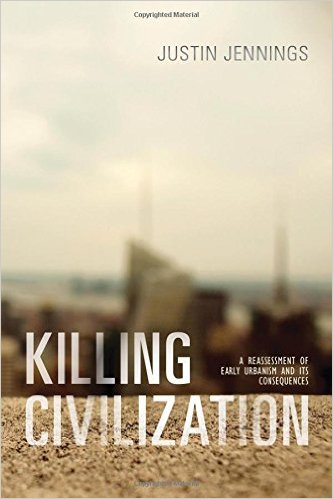

A recent book by Justin Jennings, called Killing Civilization: A Reassessment of Early Urbanism and its Consequences provides more evidence for the need to separate cities and states in the distant past. This is a fantastic book, and I will blog about it in more depth before long. For now, I want to emphasize one particular strand of Jennings's argument. He proposes two reasons why archaeologists and anthropologists should abandon the concept "civilization." First, the concept "helped justify colonial and racist projects of the 19th and early 20th centuries" (p. 266). If some societies are "civilizations" and others are not, this implies some peoples are civilized and others are not. But this is more of an evaluation, a value judgment that has often justified racism, and less of an analytical term. Therefore scholars should give up the concept of civilization. I agree.

Second, the idea of civilization—as in "the rise of civilization"—confuses state formation and urbanization by implying that they are both parts of a single package that came into being all at once. Much of Jennings's book is devoted to examples of early urban settlements that developed prior to state organization. If urbanization preceded state formation, then these two processes must be disentangled if we are to make any sense at all of early developments. I REALLY agree!

This last point gets into the broader and very important issue of how urbanization generates changes in society, and how the results of living together in dense settlements may have led to early state formation. This is a theme I have been working on recently; see some of my prior blog posts (such as Cities as social reactors, or Settlement scaling and social science theory). I have some papers in press and under review on this topic. But this kind of new approach only makes sense when archaeologists have actually disentangled processes of urbanization and state formation. From the point of view of comparative social-science research on cities, this is a no-brainer. But some archaeologists still need to wake up to urban reality, and Justin Jennings's book is a big step in the right direction.


Chick, Garry
1997  Cultural Complexity: The Concept and its Measurement. Cross-Cultural Research 31: 275-307.

Ember, Carol R. and Melvin Ember
2009  Cross-Cultural Research Methods. 2nd ed. AltaMira, Walnut Creek, CA.

Jennings, Justin
2016  Killing Civilization: A Reassessment of Early Urbanism and its Consequences. University of New Mexico Press, Albuquerque.

Monday, October 15, 2012

The power of the state to remake cities

Paris before and after Haussmann
Cities are always connected closely to their controlling governmental regime. Rulers often create, or re-make, capital cities in order to make political statements. Urban planning and architecture can convey public messages about power, control, memory, legitimacy, symbolism, and other governmental concerns. Cities that are not capitals usually have to accommodate rulers, officials, or bureaucrats who manage, supply, or regulate them. It is impossible for us to fully understand the forms and activities of cities--ancient or modern--without taking their political or administrative context into account.

I have always been intrigued about the remodeling of Paris in the 19th century under the direction of Baron Haussmann. When Cindy and I were in Paris a couple of years ago, we visited the apartment of a friend. She lived in an old building, and her apartment had a strange shape and layout. She told us that Baron Haussmann had widened her street, and in the process the front part of the building (perhaps 3 to 5 meters) had been shaved off and a new exterior wall added. What had been a narrow curving alley was turned into a wider and straight street.

1789
1999
The Paris we see today is largely a creation of Baron Haussmann. This is not to deny that the layout of the earlier Roman and Medieval cities influenced the form of contemporary Paris - these influences are clear throughout the center of the city.  (And when you visit Paris, be sure to tour the excavations of the Roman and Medieval ruins under the plaza in front of Notre Dame. You go down a poorly marked stairway that looks like a metro stop, at the opposite end of the plaza from the cathedral. The ruins are fascinating, and the exhibit is very well done.)

Marville and Moncan images
In 1852, the French ruler Napoleon III hired  Baron Haussmann to modernize Paris, and the two decades of work produced perhaps the largest urban renewal project of all time. There were several components of Haussmann's remodeling: wide straight boulevards, a new sewer system that ran beneath them, and a new emphasis on railroad tracks and train stations. Planning historian Peter Hall has this to say about the boulevards:
They would simultaneously achieve several key objectives: they would free up traffic, give access to the new [train] stations, make the suburbs accessible, clear slums to make the city healthier, create a monumental city that would be the envy of the civilized works and--not least--guard the city against demonstrations and civil disturbances. (Hall 1998: 718).
Rounding up the Commune, 1871
Riots and demonstrations had been a real problem in nineteenth century Paris, and the narrow crooked streets made it easy for demonstrators to wall off sections of the city to keep the police and military out. Haussmann's redesign didn't eliminate public rebellions in Paris, but as the members of the Paris Commune in 1871 found out, the wide streets made it much easier for authorities to put down the rebellion and round up the rebels.

Marville and Moncan images
Most of the photos in this post are before/after pictures of specific places in Paris. Photographer Charles Marville took many photos in Paris before and during Haussmann's project, and they are fascinating (and very high quality) images. More recently, photographer Patrice de Moncan located the positions of many of Marville's images and took photos of those places today. They are published side-by-side in Marville and Mancon (2010), a fantastic book. Many of Marville's photographs are posted online, and there are other books that publish large collections.

Urban renewal
Some of my favorite Marville photographs are the shantytown images. While there are slums ringing Paris today, we usually don't think about the city being filled with shantytowns. But this shouldn't be surprising; see some of my earlier posts on shantytowns, or on visual and spatial order in cities.

One of Haussmann's sewers
Hall notes that left-wing critics of Haussmann have "argued that the demolitions were deliberately designed to clear neighborhoods with a strong working-class revolutionary consciousness" (Hall 1998:728). Haussmann was very attuned to the importance of neighborhoods in cities, and he designed the system of urban districts (arrondissments) still used today. The older neighborhoods had been grass-roots places where residents organized themselves (whether to simply structure and help urban life, or to resist the state). The new districts, by contrast, were administrative units imposed by the state to help regulate Paris. See some of my prior posts, such as "Do all cities have neighborhoods?", or "Neighborhoods in semi-urban settlements."


Teotihuacan
It is much harder to study urban renewal projects at ancient cities, before photography and before extensive historical documentation. If Haussmann had been redesigning Augustan Rome, we would probably know his name and have some idea of what he did. If he had been redesigning Teotihuacan, we would never know his name and we would have only the faintest idea that the city had been redesigned. In fact there was a program of urban renewal at Teotihuacan. Most of the residential neighborhoods of the ancient city were built over a single period of a century or less, covering what had been earlier houses, fields, and irrigation canals. Was there an ancient Baron Haussmann in charge of this operation? Was he an direct state official or an independent contractor? Did the public make fun of him in political cartoons? The more we can learn about how city forms and planning relate to social conditions and activities, the better we will be able to understanding ancient urban changes. And the better we can understand ancient cities, the better our chances of figuring out what is universal and what is unique in cities in the wide urban world, across the ages.

Gandy, Matthew
Haussmann as a busy beaver
1999    The Paris Sewers and the Rationalization of Urban Space. Transactions of the Institute of British Geographers 24 (1): 23-44. 

Hall, Peter
1998    Cities in Civilization. Pantheon, New York.

Jordan, David P.
1995    Transforming Paris: The Life and Labors of Baron Haussmann. Free Press, New York

Kirkman, Emily
2007     Haussmann's Paris: Architecture in the Era of Napoleon III. Art History Archive (online).

Marville, Charles and Patrice de Moncan
2010    Paris, Avant Après: 19e siècle, 21e siècle. Les Editions du Mécène, Paris.