Showing posts with label Mesoamerica. Show all posts

Sunday, October 7, 2018

Thinking about the art of Teotihuacan

This post consists of an outline of themes and topics that relate to the art of Teotihuacan. It is focused on the objects in the exhibit, Teotihuacan: City of Water, City of Fire, currently at the Phoenix Art Museum. This is not a guide to the exhibit. Instead, I describe some of the main themes, gods, contexts, media, and rituals, all found in the objects at the exhibit. For more information about Teotihuacan, see an earlier post on this blog, "Resources on Teotihuacan."  I am an archaeologist, not an art historian, and I am a relative newcomer to Teotihuacan research. If you find errors or problems in the list, or if you have suggestions or reactions, please feel free to email me.


Themes and categories in the exhibit, “Teotihuacan: City of Water, City of Fire”

Dr. Michael E. Smith, Arizona State University,  October 6, 2018

Major Themes in the exhibit

1.       Religion and ritual (most items relate to these)
2.       Wealth and prosperity (the overall impression of all the objects, and the city)
3.       Foreign connections (see especially the Zapotec stela and urn from Oaxaca)
4.       Urbanization (city size, economic activities, housing, domestic ritual)
5.       Aztec heritage (gods and other elements from Teotihuacan were later used by the Aztecs)

The Main Gods:

1.       Storm god (goggle eyes, fangs and curled upper lip, holding lightning bolts), Rain, storms, fertility; also, military might and battle.
2.       Old fire god (sculptures, an old man sitting cross-legged with a receptacle for a hat).
3.       Feathered serpent (pretty obvious).

Contexts:

·       The tunnel under the Feathered Serpent Pyramid (objects near the entrance)
·       Pyramids:
o   Pyramid of the Sun
o   Pyramid of the Moon
o   Feathered Serpent Pyramid
·       Civic complexes:
o   Xalla
o   Plaza of the Columns
·       Residences

Media:

·       Mural paintings (fresco technique)
·       Large stone sculptures (of basalt, andesite)
·       Masks, statues, and other objects of fine-grained stone
·       Jewelry and small objects
·       Almenas (roof ornaments: geometric, animal-form, and storm-god images)
·       Stucco-painted ceramic vessels (fresco technique; vessels from domestic offerings)
·       Other ceramic vessels
·       Ceramic figurines
·       Shell and animal bones
·       Obsidian cores

Rituals:

·       Offerings
·       Incense
·       Scattering
·       Sacrifice


For more information, see my prior post.  Or check out the Twitter feed of the ASU lab at Teotihuacan:  https://twitter.com/asuteolab, or mine: https://twitter.com/MichaelESmith.

Tuesday, December 8, 2015

Religion and early cities in Mesoamerica

When you hear "religion" and "early cities" in the title of a work, watch out! Chances are, you are about to read a speculative account about the mystical symbolism of ancient cities. This is a popular topic in some circles. The basic argument is that all ancient cities were highly sacred places, and that this religious symbolism was the reason people moved into cities. Religion shaped peoples' lives, perhaps even more than everyday activities. At its most extreme, this reasoning slips into the silly notion that ancient people worried about death and the afterlife more than they thought about their daily life. Egypt is the most common target of this silliness, although the Classic Maya and other ancient societies have also been implicated. Give me a break! Ancient peoples were no more obsessed with death and the afterlife than you or I.

Now, there is a more respectable line of thought on ancient religious symbolism and cities, but it too is often slips into speculation and even nonsense. Associated with the historian of religion Mircea Eliade, it goes like this. Ancient peoples believed that life on earth was a direct parallel of the cosmos. When cities were built, especially political capitals, they were more successful if they were planned and laid out as models of the cosmos. Since the cosmos are laid out in a four-directional plan (north-east-south-west, with a center point), then cities should follow an orthogonal layout, with a center point where the north-south and east-west axes met. This model does fit some early urban traditions--most notably in China, India, and
Southeast Asia. For early cities in these regions, we have written texts and images that clearly illustrate how cities and buildings were laid out to mimic the organization of the cosmos. Such cities and buildings are often called "cosmograms."

The idealized Chinese city above was a kind of cosmogram, but the Aztec city next to it (actually the sacred precinct of Tenochtitlan) was NOT a cosmogram. How do we know? Because we have written and pictorial records that describe the symbolism of the Chinese city, how it was laid out in imitation of the cosmos, and how emperors picked the sacred place to build their new capital city (see below).


For some reason I have yet to figure out, this idea of cosmograms has been so attractive to some scholars that they go out of their way to find cosmograms all over the place. For China or India, this is fine. But when they start talking about cosmograms in ancient Mesoamerica, they are arguing more from personal bias than from evidence. There are NO WRITTEN RECORDS claiming that Aztec or Maya cities, for example, were cosmograms. But that hasn't stopped these scholars from claiming to have found cosmograms. If you haven't guessed, this kind of speculation dolled up as scholarship drives me up the wall. Ten yeas ago I published two critiques of this kind of reasoning (Smith 2003, 2005), but it still persists in some quarters.

So perhaps I can be excused if I got worried at the title of a new book from David Carballo of Boston University: Urbanization and Religion in Ancient Central Mexico. Would this be the same old kind of speculative account, claiming that ancient people went around pondering the mystical symbolism of their cities? Thankfully, the answer is NO. Carballo finds ways to address the relationship between cities and religion that is based on evidence, and uses contemporary social concepts such as collective action theory rather than the worn-out universal claims of Eliade and his followers.

Rather than worrying too much over the content of religious symbolism, Carballo looks at rituals: actions that people carried out in specific places, that left material traces:
I am less interested in attempting to define religion in an overarching sense and more interested in examining what religion did and the spatiality and temporality of its performance, within the context of urbanization.   (p. 19)
Hear, hear, this is the kind of approach we need more of in Mesoamerican archaeology. For Carballo, ceremonies in formal plazas generated social cohesion in urban populations, contributing to the success of urban life in the centuries leading up to the great Classic-period urban center of Teotihuacan. Carballo does not ignore the content of ancient religious ideas, and his discussion is reasoned and evidence-based:

Issues of greatest collective concern -- such as creation, existential dualisms, and fertility cycles -- fostered cohesion and, in continuing to feature prominently in indigenous religion, have proved the most resilient. In contrast, group divisions along the lines of lineage, status, and community were fostered through other means and saw much greater turnover through time.  (p. 201)

This is an excellent book, and I recommend it for anyone interested in the Mesoamerican past and anyone interested in new ways to look at how religion and urbanization were intertwined in the early states.

Carballo, David M.
2015    Urbanization and Religion in Ancient Central Mexico. Oxford University Press, New York.

Smith, Michael E.
2003    Can We Read Cosmology in Ancient Maya City Plans? Comment on Ashmore and Sabloff. Latin American Antiquity 14: 221-228.

2005    Did the Maya Build Architectural Cosmograms? Latin American Antiquity 16: 217-224.

Wednesday, March 27, 2013

Teotihuacan, Ancient Mesoamerican Metropolis


Here are the top ten reasons why Teotihuacan is the most important ancient city of the Americas.
 
View down the Avenue of the Dead, from the Pyramid of the Moon


(1) Teotihuacan was one of the earliest cities in the New World.


I hesitate to call Teotihuacan THE earliest city, for several reasons. First, that designation depends on one's definition of city and urbanism; and second, archaeologists continue to locate new cities and provide better dating for known cities. Nevertheless, Teotihuacan ("Teo" for short) was AN early city in central Mexico, certainly the earliest large city in the region. Teo was founded several centuries before Christ, and it reached its height between about 200 and 600 AD.


(2) Teotihuacan was one of the largest cities in the world.


Population estimates for Teotihuacan range from under 100,000 to as many as 200,000 residents, living in an urban area larger than 20 square km. Early in its period, Constantinople had over 400,000 residents, and by the end of Teo's height Chang'an in China had that many people or more. Teotihuacan was not far behind, and it was clearly the largest city in the New World.


(3) Teotihuacan was the most extensively planned ancient city in the New World.

Central Teotihuacan

After an initial period of settlement, the city of Teotihuacan was rebuilt following an orthogonal grid plan. Nearly every one of the several thousand buildings was lined up with the approximately North-South alignment of the "Avenue of the Dead." While I have written articles arguing that ancient urban planning was far more varied than just the grid plan (see article here), the degree of central political control implied by the Teo grid is impressive. The city's rulers clearly had considerable power to enforce their will, destroying irrigated farmland for urban development, and making all buildings conform to the main grid. Urban planning in ancient cities can be measured by the degree of coordination among buildings and spaces (very high at Teo), and by the area to which the planning is applied (again, large at Teo).


(4) Teotihuacan looked more like a modern city than other ancient cities did.


Phoenix
Of course past cities should be judged on their own merits, and their resemblance (or not) to modern cities is irrelevant to how we understand their operation and significance. But on the other hand, the resemblance of Teotihuacan to modern cities is striking, and that is an interesting observation. The major features that the city shares with U.S. grid-planned cities (such as Phoenix) include: its use of orthogonal grid planning; its large size; its overall spatial pattern, with big civic buildings in the center and low-rise residences spreading out for miles; and its location in a semi-arid environment where irrigation agriculture was important. So what do these similarities imply? Good question. Minimally, this is just one of many fascinating traits of Teotihuacan.


(5) Teotihuacan was the setting for a radical social experiment.


Apartment compound
Apartment compound
Teotihuacan stands out as radically different from most Mesoamerican cities along a number of social dimensions. First, the orthogonal planning is highly distinct. Second, the housing (large multi-family apartment compounds) is far more standardized and regimented than in other cities. Third, many of the artifacts seem greatly standardized. And fourth, we have virtually no information about the rulers of Teotihuacan. There are no sculptures or paintings of their faces, and archaeologists are not even sure which building was the royal palace. Many Teotihuacan scholars think that these features are evidence for a radical social experiment in regimented and anonymous living. From my perspective as an urban scholar, I am impressed by the complete divergence of Teotihuacan from older and established canons of Mesoamerican urban planning (I have an earlier post on this). Again, the urban layout points to a radical social change early in the city's history.


(6) Teotihuacan influenced later societies such as the Toltecs and the Aztecs.

The Teo feathered serpent evolved into the Aztec god Quetzalcoatl

The capital cities that followed immediately upon Teotihuacan's collapse--Xochicalco, Teotenango, Cacaxtla, Xochitecatl--all returned to ancient Mesoamerican principles of urban planning and layout. Their rulers apparently rejected the Teo innovations (grid planning, arranged around an avenue rather than a plaza, etc.). While some of my colleagues have claimed that the next really large city--Tula (height, AD 900-1100)--was a copy of Teotihuacan, in fact Tula fits in with those other cities listed above in following the basic Mesoamerican urban plan. The rulers of Tula evidently rejected the Teo innovations also. But when the Aztecs came along (they were immigrants from northern Mexico), they were really impressed with the ruins of Teotihuacan and Tula. While the Aztecs invented stories that their kings were descended from the kings of Tula, they looked to Teo as the origin of the universe. Several of the Aztec origin myths were set in Teotihuacan, and the names we use today (such as "Pyramid of the Sun" and "Avenue of the Dead") were in fact the names that the Aztecs gave to the ruined features of Teotihuacan. Aztec kings even went to excavate at Teo, and brought back Teo objects to bury as offerings at the major temple.

(7) Teotihuacan’s trading and conquests affected much of Mesoamerica.


Tikal (Maya city): the platform at left was built in Teo style
The foreign influence of Teotihuacan was greater than any other Mesoamerican city. First, Teo was capital of a small empire that conquered much of central Mexico. While this empire was far smaller than the later Aztec empire, two other kinds of Teo influence stretched farther afield than the Aztecs managed to go. Teotihuacan engaged in trade with most of the known parts of Mesoamerica. Its merchants or officials controlled the major obsidian quarries near Pachuca, and the distinctive green-tinted Pachuca obsidian was traded by Teotihuacan merchants to the Maya region and beyond. Indeed, even a central Mexicanist like me managed to excavate some green obsidian blades in the six months my wife and I worked at the Maya city of Copan in Honduras. And then another kind of Teo influence--architectural and royal styles--also spread throughout Mesoamerica, including the Maya realm. Teo style was the "in" style, the "Gangnam style," of its period. Kings all over Mesoamerica built temples in the distinctive Teo style, and Teotihuacan royal costume elements became the rage among Maya kings. No Aztec empire, trade, or stylistic influence spread nearly so far as that of Teotihuacan.

(8) Teotihuacan is one of the most extensively studied ancient cities in the Americas.

19th C. painting by José María Velasco

Countless archaeologists have worked at Teotihuacan over the decades. Formal archaeological work started in the nineteenth century. Mexican teams cleared much of the architecture along the Avenue of the Dead in preparation for the Mexican Olympic Games in 1968. René Millon and George Cowgill mapped the city in its entirety in the 1960s and 1970s.  William Sanders surveyed the surrounding countryside in the 1950s and 1960s. Many projects by Mexican, U.S., European, and Japanese archaeologists have uncovered the apartment compounds and temples of Teotihuacan. Rubén Cabrera has excavated counless buildings at Teo, and Linda Manzanilla has directed a varied program of high-quality recent fieldwork at the site. Several excavation projects have located royal tombs under the  main pyramids at the site. There are two major continuously-functioning laboratories at the site, one sponsored by the Mexican government and one by Arizona State University. My colleague George Cowgill is the preeminent Teo scholar today, and his publications give the best overviews of the site.

(9) Teotihuacan is a World Heritage Site visited my millions of tourists each year.

Tourists climb the Pyramid of the Moon

The importance of Teotihuacan is recognized all over the world, and millions of tourists visit the site each year. While this volume of visitors can damage the ruins, there are many benefits of public exposure. People learn about the Mexican past, about the work of archaeologists, and about the distinctiveness of a great ancient city. The site is an official UNESCO World Heritage site.

(10) I wrote my senior honors thesis on Teotihuacan

My first season in Mexico (at Tula)

Okay, so this is not really a reason for the greatness or importance of ancient Teotihuacan. But for me, writing a senior honors thesis on Teotihuacan (directed by George Cowgill at Brandeis University) was a transformative experience. Intellectually, that project stimulated and cemented my interests in Mesoamerican archaeology and in the study of ancient cities. I lived for a summer in San Juan Teotihuacan, a village built on top of the ancient city, and split my time between working in the Teo laboratory and doing fieldwork with William Sanders (and visiting Tula; see photo). I left Mexico that year in love with the country, the people, the food, the music, and (especially), the archaeology. And after several decades, I am still going back to central Mexico every year.


A Few Publications on Teotihuacan:

Cowgill, George L.
1997    State and Society at Teotihuacan, Mexico. Annual Review of Anthropology 26: 129-161.

2007    The Urban Organization of Teotihuacan, Mexico. In Settlement and Society: Essays Dedicated to Robert McCormick Adams, edited by Elizabeth C. Stone, pp. 261-295. Cotsen Institute of Archaeology, UCLA, Los Angeles.

2008    An Update on Teotihuacan. Antiquity 82: 962-975.

Manzanilla, Linda (editor)
1993    Anatomía de un conjunto residencial teotihuacano en Oztoyahualco. 2 vols. Instituto de Investigaciones Antropológicas, Universidad Nacional Autónoma de México, Mexico City.

1996    Corporate Groups and Domestic Activities at Teotihuacan. Latin American Antiquity 7: 228-246.

Millon, René
1992    Teotihuacan Studies: From 1950 to 1990 and Beyond. In Art, Ideology, and the City of Teotihuacan, edited by Janet C. Berlo, pp. 339-429. Dumbarton Oaks, Washington, DC.

Millon, René, R. Bruce Drewitt, and George L. Cowgill
1973    Urbanization at Teotihuacan, Mexico, Volume 1: The Teotihuacan Map, Part 2: Maps. University of Texas Press, Austin.

Sugiyama, Saburo
2004    Human Sacrifice, Militarism, and Rulership: The Symbolism of the Feathered Serpent Pyramid at Teotihuacan, Mexico. Cambridge University Press, New York.

Sunday, June 17, 2012

Ancient Urban Sustainability

Why did some past cities flourish for many centuries, even millennia, while others grew and declined over a period of years or a decade?
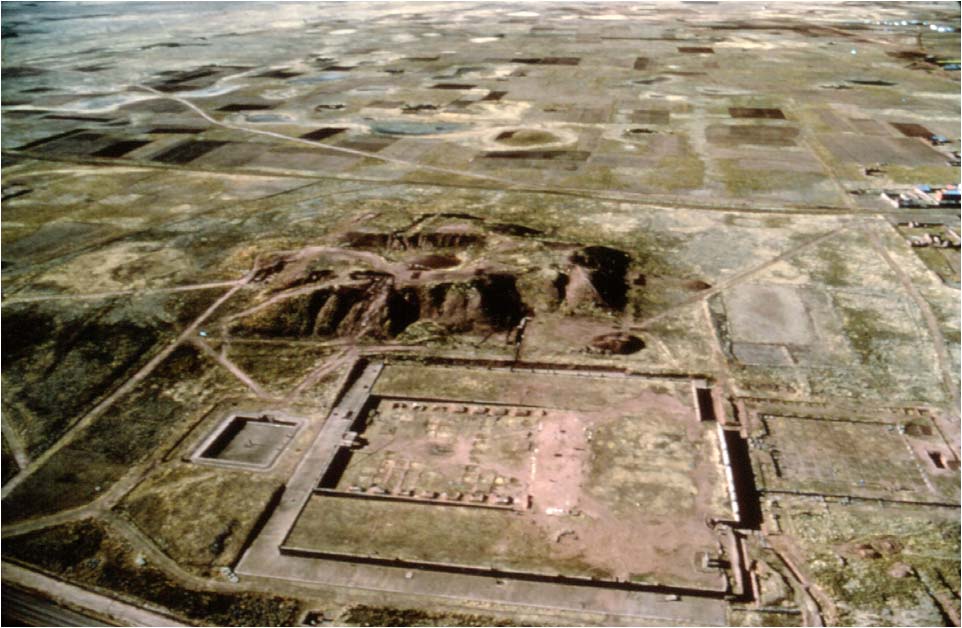
Tiwanaku: sustainable city??
Archaeologists have an incredibly extensive set of data on ancient urban sustainability, but we have yet to pursue targeted analyses of those data. I think that someday we will be able to answer the question posed above, but we are not yet close to an answer. I am following a theme I first addressed in my 2010 paper, "Sprawl, Squatters, and Sustainable Cities: Can Archaeological Data Shed Light on Modern Urban Issues?" Cambridge Archaeological Journal 20:229-253. I make the same point for all three topics -- that archaeologists have relevant data, but have not analyzed it yet in ways that can contribute to contemporary debates on urban issues.

I assigned my 2010 article in my ancient urbanism class (advanced undergrad) a year ago. One perceptive student (Seven Tomek) asked why I wasted time describing what archaeologists had not done yet - why didn't I just go out and do the analyses? Well, if I didn't already have several other research projects that take up most of my research time, I would do that. But it will take considerable dedicated effort to turn existing archaeological data into systematic and useful findings that are relevant to contemporary urbanization.

The Yautepec Valley of Morelos
Here I will review one of the examples originally included in my 2010 paper: the longevity of settlements in the Yautepec Valley of central Mexico. This is based on a full-coverage regional survey that I carried out with two graduate students, Timothy Hare and Lisa Montiel (for details see our technical report or their dissertations). Actually, they did most of the work! For my 2010 paper I identified all "urban" sites located in the survey. This was a quick-and-easy definition: any site larger than the smallest Aztec city-state capital was counted as urban. The rationales is that we know the Aztec sites were functionally urban, so this was a convenient cut-off for earlier sites as well.

My measure for sustainability was longevity; that is, how long were cities occupied? This fits theoretical discussions in the sustainability literature that stress longevity as a marker of sustainability (e.g., Bernard C. Patten and Robert Costanza  (1997)  Logical Interrelations between Four Sustainability Parameters: Stability, Continuation, Longevity, and Health. Ecosystem Health 3(3):136-142). I arranged sites in chronological order, from the earliest urban sites (Late formative Period) up to the Aztec period. Here is the graph:

Longevity of urban sites in the Yautepec Valley. Each vertical bar is an urban site.

I should start out by saying that I have yet to carry out a systematic analysis of these data. My remarks here are impressionistic and suggestive, not definitive.There were several waves of urbanization. The first, in the Late Formative period (green bars), generated three cities that flourished for over a millennium. Their success is almost certainly due to their locations: adjacent to the the largest expanse of rich farmland in the entire Yautepec Valley. The biggest single wave of urbanization occurred in the Classic period (red bars), when the valley was conquered by an empire based at Teotihuacan. These towns probably organized the cultivation of cotton and its shipment to Teotihuacan. When Teotihuacan influence waned after a couple of centuries, these sites were abandoned (except for one).

Shortly thereafter, a period of lowered rainfall set in (yellow on the map), and few new cities were founded. The increased rainfall in the 12th century AD coincided with the arrival of the Aztec peoples in this area. A new wave of urbanization took place, first in the Early Aztec period, and then in the Late Aztec period. These new cities were small capitals of city-states. Most were then destroyed in the Spanish conquest of 1521.

While this description is too provisional and subjective to produce definitive results, a few implications can be drawn. First, a range of factors must be considered in explaining the longevity or success of ancient cities. These include soil quality, rainfall, imperial conquests, and local demographic processes. Second, different causal factors came into play at different periods. Classic period urbanization was part of imperialism, whereas earlier cities were formed and flourished for largely environmental reasons. Third, these results suggest that if archaeologists were to assemble parallel data form other survey projects, we would learn quite a bit about why some cities flourished for many centuries while others did not.

I deal with ancient urban sustainability in an earlier post:

Were ancient cities sustainable?

REFERENCES:

Hare, Timothy S.  (2001)  Political Economy, Spatial Analysis, and Postclassic States in the Yautepec Valley, Mexico. PhD dissertation Dissertation, Department of Anthropology, University at Albany, SUNY.

Montiel, Lisa  (2010)  Teotihuacan Imperialism in the Yautepec Valley, Morelos, Mexico. PhD dissertation Dissertation, Department of Anthropology, University at Albany, SUNY.

Smith, Michael E. (editor)  (2006)  Reconocimiento superficial del Valle de Yautepec, Morelos: informe final. Report submitted to the Instituto Nacional de Antropología e Historia.