Showing posts sorted by relevance for query "energized crowding". Sort by date Show all posts

Tuesday, November 15, 2016

Energized Crowding Turns Cities into Social Reactors

What is is about cities that makes them exciting and dynamic? Things are happening in cities and people are attracted to them. As Jane Jacobs said, “Cities have the capability of providing something for everybody, only because, and only when, they are created by everybody.” Some cities never sleep. Cities are the setting for activities that just aren't found in smaller settlements. The more people in a city, the more activity and the more excitement. This is not just a feature of contemporary cities:  ancient cities like Teotihuacan were also bustling, dynamic, and attractive places. Architectural historian Spiro Kostof coined the term "energized crowding" to describe this aspect of urban life and society.

Energized crowding doesn't just describe the condition of life in cities - it describes the basic social forces that lead cities to grow and to transform life and society. This is the basis of the work on settlement scaling by the Social Reactors Project: me and Jose Lobo at Arizona State University, Scott Ortman at the University of Colorado, and Luis Bettencourt at the Santa Fe Institute. Check out our website. In our model, the process of energized crowding turns cities into social reactors.

As the number of people in a settlement increases, the number of potential social interactions grows at an exponential rate (see graph). As settlements grow larger, the effects of social interaction are amplified. These include positive, negative, and neutral effects. Let's start with the negative side of things. As we as individuals have to deal with more and more people, we get overloaded. Too many people, too much going on. This is called scalar stress. Some of the effects are highly negative--more people means more crime, more poverty, more social alienation. But scalar stress is offset by one of the big "nuetral" effects of growing settlement: the formation of neighborhoods. As cities grow, people adjust their activities so that they can live life on a smaller scale--the neighborhood. As I have said many times in this blog, neighborhoods are one of the very few universals of the urban experience. Here are a few posts on this (out of many.....):
 But there are also positive effects of energized crowding. Urban economists and economic geographers have known for a long time that when businesses and industries concentrate themselves in cities, it leads to economies of scale and thus major gains in productivity. These effects are called agglomeration effects, as in this diagram:
But it turns out that the positive effects of concentration and energized crowding are not limited to the modern industrial economy. In fact, they occur in cities before the industrial revolution, whether medieval European cities, or cities in the Roman or Inka empires. This fact alone shows that these effects are not due to factories, wage labor, advanced transportation, or other attributes of modern economies. In fact, these effects arise primarily out of the very act of social interaction within the built environment.

This realization was a real breakthrough in our understanding of the nature of city size and its role in generating the social and economic properties of cities. The key paper is Bettencourt (2013). Luis derives a quantitative model that predicts characteristics of cities based on their sizes, within a given region or urban system. The beauty of the model is that its conditions are general enough to fit cities before the modern era. In fact they also should work for non-urban settlements in agricultural village societies (and they do!).

Below is my diagram of energized crowding (from Smith 2017). When population grows, leading to higher densities, energized crowding increases. This can happen from regional population growth, or it can arise from the process of people moving into cities. The three results shown here are the negative, neutral, and positive outcomes of energized crowding.


In the time since Luis's 2013 article, our group has been scouring archaeology and history for cases where we can try out the model. Scott Ortman initiated this work with his studies of the settlement in the prehispanic Basin of Mexico. We've published a number of studies, and a bunch more are in the pipeline. Scott has even found the same scaling effects in village societies. The data requirements are heavy (a sample of 30 or more settlements from a given region and time period, with population estimates and other quantitative data to scale against population). If you think you know of any such cases, please let me know!

We have found the same quantitative relationships in modern and ancient settlement systems. This suggests that the same or very similar fundamental social processes operate when humans come together in settlements, whether today or two thousand years ago. Energized crowding--which is at a much higher level in larger settlements--has measurable effects on the density of settlement, and on the levels of economic and social outputs. In this figure, Graph A shows economic output measures for the modern U.S. economy, while Graph B shows wealth output for the ancient Inka economy. Quantitatively these two graphs are nearly identical. Both exhibit "superlinear scaling," with beta coefficients of 1.13.

So, how far can we push these relationships? Are they universal? Well, not quite. Hunter-gatherer campsites show very different patterns from the agricultural societies we have studied so far. This is something we are working on now. But for most systems we have examined, we find similar patterns, and when we apply Luis's model, we conclude that energized crowding turns settlements into social reactors.

For some other posts on the scaling work, see:
See our project website for more information.


Bettencourt, Luís M. A.  2013    The Origins of Scaling in Cities. Science 340: 1438-1441.

Cesaretti, Rudolf, Luís M. A. Bettencourt, Jose Lobo, Scott Ortman, and Michael E. Smith 2016    Population-Area Relationship in Medieval European Cities. PLOS-One: 11:(10) e162678.  .

Ortman, Scott G., Andrew H.F. Cabaniss, Jennie O. Sturm, and Luís M. A. Bettencourt
2014    The Pre-History of Urban Scaling. PLOS-one 9 (2): e87902.

2015    Settlement Scaling and Increasing Returns in an Ancient Society. Science Advances 1 (1): e1400066.

Ortman, Scott G. and Grant D. Coffey  2015    Universal Scaling: Evidence from Village-Level Societies. SFI Working Paper, vol. 15-10-044. Santa Fe Institute, Santa Fe. 

Ortman, Scott G., Kaitlyn E. Davis, José Lobo, Michael E. Smith, Luis M.A. Bettencourt, and Aaron Trumbo  2016    Settlement Scaling and Economic Change in the Central Andes. Journal of Archaeological Science 73: 94-106.  .

Smith, Michael E.  2017    The Generative Role of Settlement Aggregation and Urbanization. In Coming Together: Comparative Approaches to Population Aggregation and Early Urbanization, edited by Attila Gyucha. State University of New York Press, Albany.

Wednesday, January 4, 2023

My book, Urban Life in the Distant Past: The Prehistory of Energized Crowding, will be published in February/March, 2023, by Cambridge University Press. This provides one reason to re-start this blog. Another reason is to explore some of the issues in early and comparative urbanism that I have been working on for the past few years. The Covid-19 pandemic coincided with a general decline in blogs and an increase in the use of twitter, and I followed along with these trends. But twitter threads are a pain to put together and they have little or no staying power. I had been intending to get this blog going again for a few years now, so here we are.

I am going to start off here with some of my publications from the past few years. I last posted here in early 2019, so I'll start with that year. Once I've gone over a bunch of my papers, I'll start blogging on the themes and content of my new book.


Publications, 2019

Smith, ME  (2019)  Energized Crowding and the Generative Role of Settlement Aggregation and Urbanization. In Coming Together: Comparative Approaches to Population Aggregation and Early Urbanization, edited by Attila Gyucha, pp. 37-58. State University of New York Press, Albany.  Available Here

Members of the Social Reactors Project
at Teotihuacan, 2019
This paper is a kind of rehearsal for my book. I wrote this as my attempt to explore the theoretical and comparative foundation of the work we were doing on settlement scaling. See this past post on energized crowding. The project website has lots of information, including all of our papers:   https://www.colorado.edu/socialreactors/ Here we are on top of the Pyramid of the Sun at Teotihuacan in 2019. Great place for a workshop on urban science!!


Teotihuacan map.
Smith, ME, A Chatterjee, S Stewart, A Huster and M Forest  (2019)  Apartment Compounds, Households, and Population at Teotihuacan. Ancient Mesoamerica 30(3):399-418.  Available Here

This paper makes several major advances in our understanding of urbanism at ancient Teotihuacan.

First, we create a new population estimate for Teotihuacan at its height. This is the most rigorous population figure ever calculated for the city. Past estimates, even those by Millon and Cowgill, were quite subjective and impressionistic. Our best estimate:  100,000 inhabitants.

Second, we confirm, extend, and built on the residential classification of the Teotihuacan Mapping Project. Millon's categories of low-status, intermediate-status, and high-status residences have withstood the test of time.

Third, and perhaps most exciting, we present a new method for determining how many households likely lived in each of the excavated apartment compounds. We use network methods, often called "space syntax" by archaeologists. While others have analyzed Teotihuacan residences using space syntax methods, we offer the most systematic and rigorous analysis. This was worked out primarily by Abishek Chatterjee, an electrical engineer at Intel and an online anthropology major at ASU. When I first explained what we needed to Abishek, and showed him the plans, he said "This is a network problem, and I can solve it." Well, he did! An important component was a set of new systematic plan maps of the excavated residences, made by Sierra Stewart.

Network analysis of Zacuala
In the example here, the compound known as Zacuala, there were four dwellings (that is, four housing areas, each with one household), plus a common area around the large central patio and platform.

This paper not only contributed to advances in understanding demography, housing and social organization, but it also forms the basis for continuing analysis of spatial patterns at Teotihuacan. We are hot on the trail of a new analysis of urban density, using concepts and methods from urban economics. If you compare 20th century cities studied by economists, do you think Teotihuacan was more like U.S. cities, or Soviet-block socialist cities? We will tell you.


Smith, ME and J Lobo  (2019)  Cities through the Ages: One Thing or Many? Frontiers in Digital Humanities, 6 (Special issue: Where to Cities Come From and Where are They Going to? Modelling Past and Present Agglomerations to Understand Urban Ways of Life):Article 12.  Click here.

This is another paper oriented toward providing a context for the work in settlement scaling. Whether one considers cities--across history and around the world--as one thing or as many things depends on what kinds of questions one asks, or what kinds of attributes one is examining. If you focus on political context, technology, energy use, or transport, then ancient cities were radically different from cities today. But, on the other hand, if you focus on the ways that people interact socially within the built environment--how that relates to population size and density, and on the positive outcomes from social interactions--then there seems to be only one type of city. These social interactions are fundamental for the dynamics and operation of cities and settlements through history, today and in the past.


I love this image! It is from the Social Reactors Project website:
https://www.colorado.edu/socialreactors/publications


Stay tuned for information on my urban publications since 2019. 


Saturday, January 14, 2023

Nailing my theses to the internet, part 2 of 2


This is the second of two posts on my fundamental “theses”: the basic principles of my approach to premodern cities and urbanism.  See the first post here:


(4) Cities and urban life are structured by the interplay between two sets of processes: centralized, or top-down, processes originate with kings, elites, and central institutions, whereas generative, or bottom-up, processes arise from the grass-roots actions of individuals not under the control or direction of institutions or authorities.


Urban life and organization is made up of a constant interplay of these two kinds of processes of change. My usage is based on common approaches in the social sciences outside archaeology.[1] I distinguish two types of generative process: Grassroots activity refers to the intentional efforts of people to organize and coordinate their activities in pursuit of a goal (Chapter 7). Spontaneous organization describes actions of daily life, including social interactions, that create some kind of order or outcome that was neither planned nor created by authorities (Chapters 3, 7). My prime example of this is energized crowding.

Figure 7.1, from Besim Hakim

While both top-down and bottom-up factors are typically in play, some realms are closer to the institutional or upper domain of society, while others lie closer to the generative realm. For example, most premodern urbanites paid taxes, and taxation is primarily an activity of the state, a top-down institution. While the generative actions of individuals and groups may affect tax collection, these are typically of less importance than the top-down demands at play. Political protest, on the other hand, is primarily a generative process; nevertheless, top-down forces may affect the nature and outcomes of protests. My discussion of urban life proper is divided along these lines: Chapter 6 focuses on institutions or top-down processes, and Chapter 7 is about generative processes. This division flows from my basic definition of cities as settlement where population and activities are concentrated.


(5) Social interactions within cities and other settlements create “energized crowding,” which is one of the fundamental causal mechanisms in urban life.


As in the case of Thesis #4, this principle also flows from my basic definition of cities. The importance of face-to-face social interaction, in the form of energized crowding, in generating social outcomes is a fundamental component of many theoretical approaches in the social sciences (Brower 2011; Glaeser 2011; Ostrom 1990; Storper and Venables 2004). This perspective has been developed into a set of formal theories with quantitative predictions, known as settlement scaling theory (Bettencourt et al. 2007; Pumain et al. 2006; West 2017). I have participated in one branch of this approach, which views cities as “social reactors” (Bettencourt 2013). We have extended research from contemporary cities into the deep past, revealing broad continuities in the role of settlement size between ancient and modern settlement systems. In this book I explore the nature and implications of social interactions for premodern cities.[2]


           An additional consideration that colors how some archaeologists write about ancient cities is what I call the “urban prestige effect.” As a legacy of rigid and universalist schemes of cultural evolution popular form the 1950s through the 1970s

(Service 1975; White 1959), many archaeologists assign a high value, with a high level of prestige, to the categories of cities and urbanism. This signals an unfortunate emotional association with the objects of their study (settlements). Urban sites are seen as “better” than non-urban settlements, resulting in attempts to categorize non-urban settlements as cities. Non-urban villages are not infrequently declared urban by one scholar or another, whether ancient sites like Çatalhöyük (see Case study 2, below) or modern Amazonian villages (Heckenberger et al. 2008). It is almost guaranteed that complex early settlements—such as the Tripalyan “mega-sites”—will be viewed as urban (Chapman and Gaydarska 2016; Diachenko and Menotti 2017), regardless of the nature of the evidence; see Chapter 2. This urban prestige effect only muddies the waters of premodern settlement analysis, contributing little to our understanding of the settlements in question, or to comparative urban studies.


REFERENCES


Bettencourt, Luís M. A.

2013    The Origins of Scaling in Cities. Science 340: 1438-1441.

Bettencourt, Luís M. A., José Lobo, Dirk Helbing, Christian Kühnert, and Geoffrey B. West

2007    Growth, Innovation, Scaling, and the Pace of Life in Cities. Proceedings of the National Academy of Sciences 104: 7301-7306.

Brower, Sidney N.

2011    Neighbors and Neighborhoods: Elements of Successful Community Design. APA Planners Press, Chicago.

Chapman, John and Bisserka Gaydarska

2016    From Domestic Households to Mega-Structures: Proto-Urbanism? In Trypillia Mega-Sites and European Prehistory,  4100-3400 BCE, edited by Johannes Müller, Knut Rassmann, and Mykhailo Videiko, pp. 289-299. Routledge, New York.

Diachenko, Aleksandr and Francesco Menotti

2017    Proto-Cities or Non-Proto-Cities? On the Nature of Cucuteni–Trypillia Mega-Sites. Journal of World Prehistory 30 (3): 207-219.

Glaeser, Edward L.

2011    The Triumph of the City: How our Greatest Invention Makes us Richer, Smarter, Greener, Healthier, and Happier. Penguin, New York.

Heckenberger, Michael J., J. Christian Russell, Carlos Fausto, Joshua R. Toney, Morgan J. Schmidt, Edithe Pereira, Bruna Franchetto, and Afukaka Kuikuro

2008    Pre-Columbian Urbanism, Anthropogenic Landscapes, and the Future of the Amazon. Science 321: 1214-1217.

Ostrom, Elinor

1990    Governing the Commons: The Evolution of Institutions for Collective Action. Cambridge University Press, New York.

Pumain, Denise, Fabien Paulus, Céline Vacchiana-Marcuzzo, and José Lobo

2006    An Evolutionary Theory for Inerpreting Urban Scaling Laws. Cybergeo: European Journal of Geography  (article 343).  http://cybergeo.revues.org/2519?lang=en.

Service, Elman Rogers

1975    Origins of the State and Civilization: The Process of Cultural Evolution. Norton, New York.

Storper, Michael and Anthony J. Venables

2004    Buzz: Face-to-Face Contact and the Urban Economy. Journal of Economic Geography 4 (4): 351-370.

West, Geoffrey B.

2017    Scale: The Universal Laws of Growth, Innovation, Sustainability, and the Pace of Lifein Organisms, Cities, Economies, and Companies. Penguin, New York.

White, Leslie A.

1959    The Evolution of Culture: The Development of Civilization to the Fall of Rome. McGraw-Hill, New York.


[1] I wish to distinguish my usage of top-down and bottom-up from a particular archaeological usage in which “top-down” refers to studies of kings and elites, while “bottom-up” denotes studies of households. My usage, in contrast, is based on drivers of change and causal mechanisms (Chapters 3, 6, 7).

[2] The research and publications of the Social reactors project are presented at: https://www.colorado.edu/socialreactors/.

Tuesday, March 28, 2017

Cities through the ages: One thing or many?

Vancouver
I am in rainy Vancouver, BC. Tomorrow I will give a lecture at Green College, University of British Columbia, with this title ("Cities through the ages: One thing or many?"), and then Thursday I head downtown for the annual meeting of the Society for American Archaeology. I first gave a talk with this title at the Santa Fe Institute in 2013. At that time I developed an argument that there are, and have been, only two basic types of cities. I called them economic cities and political cities. Most contemporary cities are economic cities (dominated by capitalist economic processes), and that most ancient cities were political cities (dominated by political dynamics). The implication (it seemed to me, though incorrectly) was that the models of urban scaling that had been worked out for modern cities should not apply to ancient cities.

The urban scaling group (Luis Bettencourt, Jose Lobo, and Scott Ortman) had invited me to SFI to explore the possibility of applying the scaling models to ancient cities. I arrived ready to tell them to forget it. Ancient and modern cities were just too different in their economies, and I mistakenly believed that the scaling regularities of modern cities derived from capitalist agglomeration processes. But within a few hours of talking with these guys, they convinced me that the basic model that explains the modern scaling results is general enough to apply to ancient cities too. I had to scramble to modify my public lecture (the next day) to incorporate this insight (Bettencourt 2013).
Tenochtitlan, the Aztec capital

So, here I am, nearly four years later, giving a talk with the same title. But now I have TWO answers to the question, "One thing or many?" From the perspective of how cities operate and how they grow, I still see two very different types of cities: economic and political. Many of the economic models of contemporary cities simply do not apply to ancient cities. But from the perspective of  how people use the built environment of settlements, and how people interact with others, and the generative implications of those interactions, there is only one type of city. In fact, I should say there is only one type of settlement, because the patterns apply to non-urban settlements as well.

The City as Two Things: Economic and Political Cities


Most contemporary cities, and some past cities, are "economic cities." Their growth and operations are dominated by the commercial economy. Relevant concepts are agglomeration processes and agglomeration effects. Wage labor employees are matched with jobs in cities; urban public goods are shared by individuals and firms; and an educated workforce leads to prductivity gains (Duranton and Puga 2004). Sounds pretty standard for modern urban economics, but many of these things just plain don't apply to ancient cities. Many of these lacked wage labor and formal education. Agglomeration effects were much smaller or very different.

In some modern cities, politics dominates economics. These tend to be the large mega-capitals of developing nations. They are known as primate cities - not primates as in Planet of the Apes - but primate in the sense that the largest city in the system is far too large. It is too large because it is a political capital in a nation-state where politics dominates economics. See DeLong and Schleiffer (1993), or Ades and Glaeser (1995) on primate cities.

But this was the standard kind of city in the ancient world. Even in a heavily (noncapitalist) commercialized economy such as Classical Rome, politics played a heavy role in urban growth and operation, and thus many of the basic urban dynamics were quite different. Much economic activity in Rome was "unproductive" in that it was oriented at luxury, not growth of productivity (Baumol 1990).
Energized crowding at work

The City as One Thing: Energized Crowding and Social Interactions


But when we look at how social interactions in the built environment lead to highly regular patterns relating settlement population to other features, there is only one basic type of settlement. This is not a claim based on theory; it is an empirical conclusion. Luis Bettencourt's (2013) model of scaling derives the quantitative relationships between population and other urban features from the basic features of social interactions within the built environment. And this model explains both the regularities of scaling in contemporary urban systems and the same regularities in ancient urban systems. See some of my prior posts on scaling for more details :

Energized crowding turns cities into social reactors - 2016

Settlement scaling and social science theory - 2016

Urban scaling: Cities as social reactors - 2013


 But if you have doubts that the archaeological results are the same as the modern results, look at this table (from Smith 2017).


To me, these studies reach the most amazing results of any research I have ever been involved with. Why should there be such regularities in the sizes of settlements within settlement systems? How can the ancient systems have the same quantitative patterns as the modern systems? The cities are different. The societies and economies are different. People work and play differently. They move about differently. But somehow, the aggregate activities of people interacting in settlements produce the same kinds of quantitative patterns anyplace we look. Well, almost anyplace - it turns out that mobile hunter-gatherers have different patterns. But that is a different story..........

My talk tomorrow will be in Green College, UBC, a residential college for graduate students, postdocs, and faculty. This is a fascinating intellectual community in a gorgeous natural and built environment. It is part of a diverse series called, "The next urban planet: Rethinking the city in tome." What a great title for a series of lectures! I am staying in the Green College Guesthouse, where I have a cozy gas fire to keep out the damp and cold. I look forward to spending time with archaeologists, urban scholars, and others at UBC tomorrow.


References

Ades, Alberto F. and Edward L. Glaeser  (1995)  Trade and Circuses: Explaining Urban Giants. Quarterly Journal of Economics 110:195-227.

Baumol, William J.  (1990)  Entrepreneurship: Productive, Unproductive, and Destructive. Journal of Political Economy 98(5):893-921.

Bettencourt, Luís M. A.  (2013)  The Origins of Scaling in Cities. Science 340:1438-1441.

de Long, J. Bradford and Andrei Shleifer  (1993)  Princes and Merchants: European City Growth Before the Industrial Revolution. Journal of Law and Economics 36:671-702.

Duranton, Gilles and Diego Puga  (2004)  Micro-Foundation of Urban Agglomeration Economies. In Handbook of Regional and Urban Economics, edited by J. Vernon Henderson and Jacques-François Thisse, pp. 2064-2117. vol. 4. Elsevier, Amsterdam.

Smith, Michael E.  (2017)  The Generative Role of Settlement Aggregation and Urbanization. In Coming Together: Comparative Approaches to Population Aggregation and Early Urbanization, edited by Attila Gyucha. State University of New York Press, Albany.

Monday, July 4, 2016

How do neighborhoods form?

Neighborhood organization is one of the few universals of urban structure. All cities, past and present, all over the world, are organized into neighborhoods. Sometimes neighborhoods are planned from the start by officials or commercial builders. Think of all the ready-made suburban neighborhoods built by developers today, with their phony bucolic- or English-sounding names. Or consider company towns, whether ancient Egyptian workers settlements or capitalist factory cities like Pullman, Illinois. The planners build in neighborhoods from the get-go. If they aren't planned out in advance, however, neighborhoods spring up on their own. People interact with those living nearby, new residents move into areas where they know people, or where people are like them culturally, and before long there are neighborhoods that are clear to residents and visitors alike.
Neighborhoods: suburban U.S., Ottoman city; Chinese city

One of the best ways to look at certain urban processes, to my mind, is to examine "semi-urban" places. These are places where large numbers of people gather together, often on a temporary basis. They aren't really cities--they aren't permanent enough. After a while, people leave and go home. But when people gather in  one place, a certain "energized crowding" takes place (see my post on Cities as  Social Reactors), and by looking at what happens, we gain a better understanding of urban processes and activities.

So, here I want to take a quick look at three very different kinds of semi-urban settlements (a company town, a protest camp, and the Burning Man festival) to see how neighborhoods develop. This post is based on a recent article (Smith et al. 2015) that looks at neighborhoods in a wider range of semi-urban settlements. I won't cite a bunch of sources here; see that article for citations and a more scholarly treatment.

Abadan, Iran, Company Town:  Top-Down Neighborhood Formation
Deir el-Medina, ancient workers village

The company town is a settlement planned and established by a central organization to house its workers so that they can work more efficiently. They tend to exhibit careful planning and regularity of housing; they show some evidence of the central authority; and they are physically set off from their neighboring settlements. We tend to think of company towns as modern features, used by capitalist enterprises. But the basic concept goes back to ancient Egypt at least. Pharaohs set up walled settlements that archaeologists call "workers villages" to house construction workers, or temple personnel. This was not by any means a capitalist economy, yet the form, function, and goals of workers villages matched closely those of a 19th century town like Pullman, Illinois. These settlements are one of the main types of what Kevin Lynch called "the city as a practical machine."

My example here is Abadan, an oil refining town set up in the early 20th century in Iran by the Anglo-Persion Oil Company (later known as British Petroleum). The company knew they would need to bring in workers from several national/cultural groups, and they were worried about possible trouble that could come if members of these groups could easily mingle with one another. So thay arranged the housing in a big band around the outside of the refinery, and
they kept individual neighborhood units separate from one another. The British executives and engineers were in one area, and various local and Near Eastern groups were distributed in other areas.
Neighborhoods laid out around the refinery, which was in the center

British neighborhood in Abadan
The plan to settle groups in physically separate neighborhoods was quite deliberate, as research into company archives has shown (see Smith et al 2015 for citations). So, Abadan ended up with a system of neighborhoods, distinguished culturally and socially, as a result of deliberate planning from the
top. Such "designed neighborhoods" are also found in other company towns, and in other regimented planned settlements such as internment camps.

Occupy Portland Protest Camp: Bottom-up Neighborhood Formation

Information from the Occupy Portland camp was gathered by Katrina Johnston-Zimmerman for her MA thesis. Katrina is an interesting urbanist; check out her "Think Urban" website or her Twitter feed. As an undergraduate at Arizona State University, Katrina worked for our interdisciplinary urban project, "Urban Organization through the Ages." She conducted ethnographic fieldwork during the "Occupy Portland" event of 2011. This was one of the many local protest camps that spring up following the initial Occupy Wall Street settlement.
Occupy Portland camp. Photo by Katrina Johnston-Zimmerman

What Katrina found was that the campers in Portland quickly formed spatial clusters of like-minded people who spent time together. They set up their tents near one another. These groups took on names. In short, these were neighborhoods. This is a clear example of the bottom-up route to neighborhood formation. People created neighborhoods on their own, following their needs and interests. No one came along and organized the campsite. In fact, the participants in the Occupy Portland event refused to submit to a top-down organization. Someone pointed out that the campsite looked messy. If they reorganized it to look neater, with tents in nice rows, then the authorities would be less likely to tear it down. (This is a basic principle in informal settlement invasions in Latin America; local governments are far less likely to destroy shantytown settlements when they have neat streets and lots than when they are a mess).  But, true to their anarchist orientation, the participants refused to submit to this top-down structure. The messy, grass-roots organized spatial organization of neighborhoods was too strong to be torn apart in an effort to please city officials.

The Burning Man Festival: From Anarchy to Planning


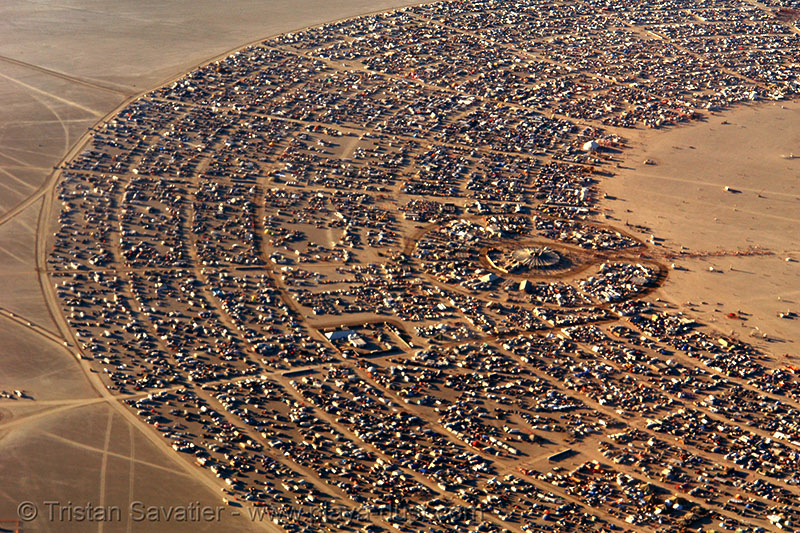
The annual Burning Man festival in the Nevada desert is a fascinating case study of a semi-urban settlement. What began as a bonfire on the beach in San Francisco in th 1980s has grown into a huge annual campsite with as many as 70,000 week-long residents. It has always been a festival of arts and free expression, run with a series of anarchist principles, including radical inclusion, decommodification, communal effort, radical self-reliance, and leave no trace. The entire settlement is taken down each year, all traces are removed or destroyed, and then it is planned, surveyed, and built again the following year. Urbanists have only just begun to study Burning Man, and there is much to learn there about cities, urbanization, and social patterns.

The Burning Man site is on federal land, and the festival receives a permit each year. As the festival grew during the 1990s, people naturally gravitated toward specific areas, forming neighborhoods. These were linked by friendship and social bonds, as well as by interests (e.g., all-night loud parties in one area; campers with small children in another). But by 1996, the event had grown too large to function on its anarchist principles. People were shooting guns in crowded places, driving cars too fast and destroying tents and injuring people. The government threatened to shut down the festival (by denying the permit) unless more order were achieved.

Almost overnight, the site -- called Black Rock City -- became a heavily planned settlement, with a circular layout and the burning man tower in the center. There is now a "Department of Urban Planning" in the Burning Man organization. Neighborhoods were either continued, or established anew, again, using social bonds and common interests as defining features. These anarchists were able to submit to some top-down planning in order to continue to celebrate their anti-authoritarian and free-expression values.

Whereever you look, there are neighborhoods!

These are just three examples of semi-urban settlements with clear neighborhood organization. Our study found neighborhoods at many other types, from Plains Indians tipi camps to refugee camps. The conclusion I draw from this study is that neighborhoods are indeed a  universal feature of urban life. Whether created and enforced by authorities (state or corporation), or generated by grass-roots action of individual acting in their own, neighborhoods are an integral and crucial part of urban organization, from the distant past to the present.

For more details, see:

Smith, Michael E., Ashley Engquist, Cinthia Carvajal, Katrina Johnston, Amanda Young, Monica Algara, Yui Kuznetsov and Bridgette Gilliland  (2015)  Neighborhood Formation in Semi-Urban Settlements. Journal of Urbanism 8(2):173-198.